
Buyer's Guide
FOB vs CIF: Which Incoterm Should You Choose?
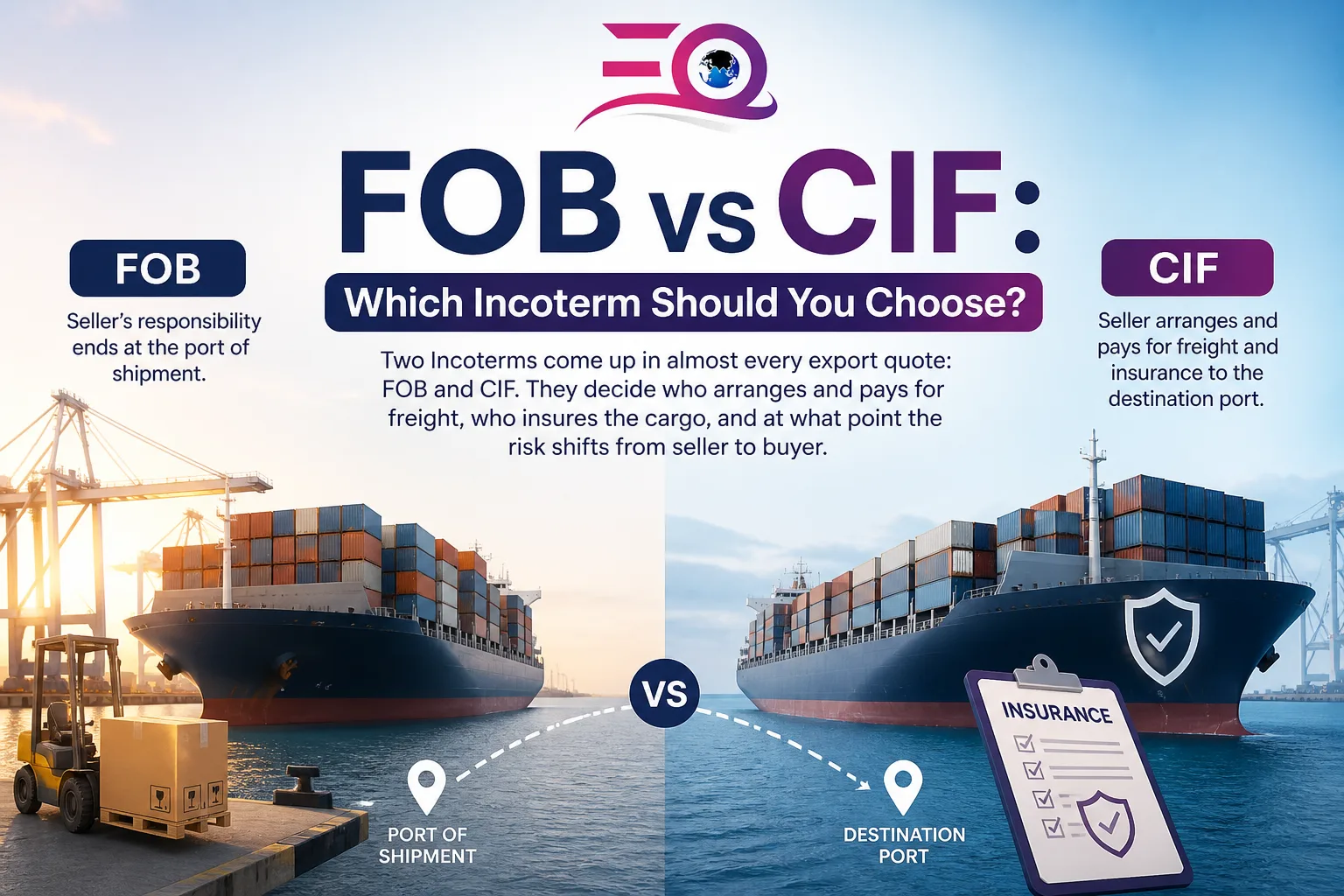
Two Incoterms come up in almost every export quote: FOB and CIF. They decide who arranges and pays for freight, who insures the cargo, and at what point the risk shifts from seller to buyer. Here's the difference in plain terms.
FOB (Free On Board)
Under FOB, the exporter's job ends once the goods are loaded onto the vessel at the origin port — for Eternal Overseas shipments, that's Mundra. From that point, you (the buyer) arrange and pay for ocean freight and marine insurance, and you carry the risk from the moment the container is on board.
FOB suits buyers who already have a freight forwarder relationship, want to shop the freight rate themselves, or need control over which shipping line and schedule is used.
CIF (Cost, Insurance, Freight)
Under CIF, the exporter arranges and pays for ocean freight and insurance up to your destination port, folded into a single quoted price. You still take on the risk once the goods are loaded — CIF doesn't change when risk transfers, only who arranged the freight and insurance covering that risk.
CIF suits first-time importers, smaller orders where it isn't worth setting up a forwarder relationship yet, or buyers who'd simply rather have one number to plan around.
The part that actually matters: landed cost
Whichever term you use, the number that matters is your total landed cost — product, freight, insurance, duties, port handling and inland transport to your warehouse, all added up. A lower FOB unit price can still land more expensive than a CIF quote once you've priced your own freight, and vice versa. Ask for both quotes on a real order before deciding, not as a general rule of thumb.
A third option: ask your supplier
Established exporters can usually quote either way, and a supplier who ships to your region regularly may already have freight rates worth comparing against your own forwarder's. Eternal Overseas quotes FOB or CIF on request — see our export overview or contact us with your destination port and we'll send both.
Talk to our export desk More guides
Frequently asked questions
Which is cheaper, FOB or CIF?
Neither is inherently cheaper — CIF folds the freight and insurance cost into the exporter's price, while FOB has you paying your own forwarder directly. Compare the all-in landed cost, not just the quoted unit price, before deciding.
Who is responsible if the container is damaged at sea?
Under both FOB and CIF, risk transfers to the buyer once the goods are loaded onto the vessel at the origin port. The difference is who arranged the insurance covering that risk — under CIF the seller arranges it (on your behalf); under FOB you arrange your own.
Can I ask for a quote in both FOB and CIF?
Yes, and it's a reasonable thing to ask for on a first order — comparing both against your own forwarder's freight quote is the fastest way to see which actually works out cheaper for your route.