
Buyer's Guide
Sanitary Ware Manufacturers in India | How to Vet a Supplier
How importers can vet sanitary ware manufacturers: product range, MOQ, documents, samples and lead time, and what to confirm before a container order.
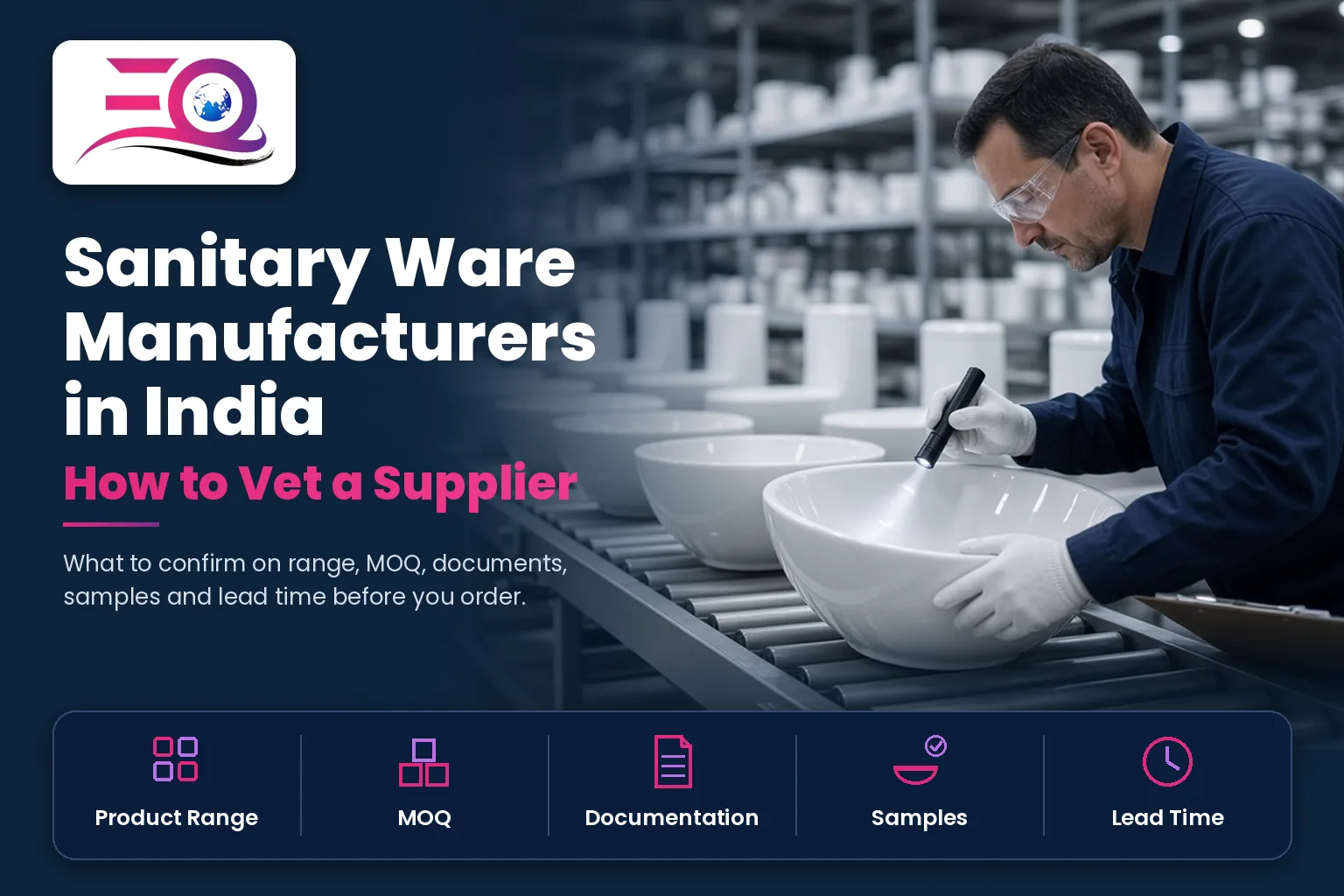
Most importers find sanitary ware manufacturers the same way: a catalogue, a few introductory emails, a spreadsheet of quotes. The trouble is that every supplier looks capable on paper. Catalogues are polished, replies are fast, and everyone promises quality. The real differences show up in the details people forget to ask about, such as what a minimum order actually means, which papers arrive with the goods and how long the whole thing takes from confirmation to your warehouse door.
This guide is about those details. If you are still deciding what to buy for a particular building, start with our piece on choosing sanitary ware for a project. What follows assumes you already know what you want to sell and need to find someone dependable to supply it.
Reading a Supplier's Product Range
Breadth Versus Depth
A long catalogue is not the same as a strong one. Some sanitary ware wholesalers list dozens of items but make only a handful themselves, and fill the rest from other factories. That is not wrong, but it affects consistency, because colour, glaze and sizing can shift between sources. Ask which products are made in the supplier's own plant and which are sourced. A direct, specific answer is a good sign.
Does the Range Fit the Way You Sell?
A dealer serving contractors wants matching sets, including closet, basin, and pedestal, that deliver uniform color, glaze, and quality. If you are supplying multi-unit developments, ensuring product consistency across every unit is critical.
(Check out our breakdown on selecting the right sanitary ware for housing projects for tips on balancing aesthetics with project budgets.) Look closely at the supplier’s range to verify whether pieces across categories share identical glazes and design standards.
Minimum Order Quantity, Properly Understood
What the Figure Is Counted In
An MOQ is only meaningful once you know its unit. It may be per model, per colour, per product category or per container. A supplier who says "one container minimum" may still let you mix models; another may demand a full container of each. Ask for the rule in writing, with an example of a mixed order that meets it.
Starting Smaller Without Cutting Corners
For a first order, many buyers want a mixed container with a modest quantity of each model. Some suppliers can accommodate that, and some cannot. If a supplier agrees to a lower MOQ, ask whether anything else changes, such as production scheduling, packing method or the batch the goods come from. A concession that quietly lowers quality has not saved you anything.
Documentation That Should Reach You
Before the Order
Before you commit, expect specification sheets for each model, with dimensions and technical details, and test reports where relevant. Check that reports name the product you are buying, not a similar one. If a supplier cites certifications, ask what each covers, since a company-level certificate and a product test report are different things. Do not assume any document is accepted in your market; confirm that locally.
At Shipment
For the export itself, you will typically need a commercial invoice, packing list and bill of lading, with other documents depending on the destination. A sanitary ware B2B exporters team that handles this regularly will know what your country asks for and will tell you before you ask. One that looks surprised by the question may be learning on your shipment. Our export page gives a view of how we approach the process.
Using Samples to Judge the Supplier
What the Sample Tells You
A sample shows you the product, but the way it is handled shows you the supplier. Note how quickly they respond, whether the sample matches what was described and whether the packing looks like what you would receive in bulk. A sample sent in careful packaging, with a clear label, suggests a business that pays attention.
Sample Versus Production
The harder question is whether production will match the sample. Ask how the supplier keeps it consistent across batches, and whether they will agree to compare a pre-shipment check against your approved sample. Keep your reference piece. If the first container differs noticeably from it, you have something concrete to point to.
Lead Time, and What Is Counted in It
From Confirmation to Loading
A quoted lead time is only useful if you know where it starts and stops. Does the clock begin at order confirmation or at payment? Does it end when goods leave the factory, when the container is loaded or when it sails? Ask for a breakdown: production, inspection, packing and transport to port.
Planning for Delay
Delays happen in ceramics production and shipping alike. Rather than trusting the most optimistic date, build slack into your own stock planning and ask how the supplier communicates when something slips. A supplier who tells you early is easier to work with than one who tells you late.
Comparing Quotes on Equal Terms
Making the Numbers Match
Two quotes are only comparable if they cover the same things. Check whether the price is ex-factory, free on board or delivered, whether packing is included and whether fittings and accessories are in or out. A lower quote that leaves out half the extras is not lower.
The Questions Worth Asking Every Supplier
To evaluate candidates objectively, submit a standardized list of critical operational questions to every prospective vendor:
- Manufacturing Source: Who actually produces the goods, and is the production handled entirely in-house?
- MOQ Structure: How are minimum order quantities calculated across standard catalog items versus custom runs?
- Trade Documentation: Which specific quality testing certificates, origin documents, and compliance records are provided?
- Production Lead Times: What is the realistic timeline from initial deposit through manufacturing to final port dispatch?
- Damage Handling: What clear protocol and financial terms govern breakage claims or off-spec shipments?
Compare responses for accuracy and consistency. A sanitary ware supplier that delivers precise, uniform answers builds far greater trust than one offering shifting details.
Talk to our export desk More guides
Frequently asked questions
What Should I Check First When Choosing Sanitary Ware Manufacturers?
Start with who actually produces the goods, then the MOQ and its unit, then the documents you will receive. These three tell you quickly whether a supplier can handle a proper export order.
How Does MOQ Usually Work for Sanitary Ware?
It varies. It can be set per model, per colour or per container. Ask for the rule in writing, plus an example of a mixed order that meets it.
Is It Worth Ordering Samples Before a Container?
Yes. Samples let you check product quality and also show how the supplier packs, communicates and follows through, all before you commit to volume.