
Buyer's Guide
Step Tiles for Stairs: Types, Sizes & Export Options
A buyer's guide to step tiles for stairs: step and riser tiles, nosing, anti-skid finish, standard sizes and packing to limit breakage in export.
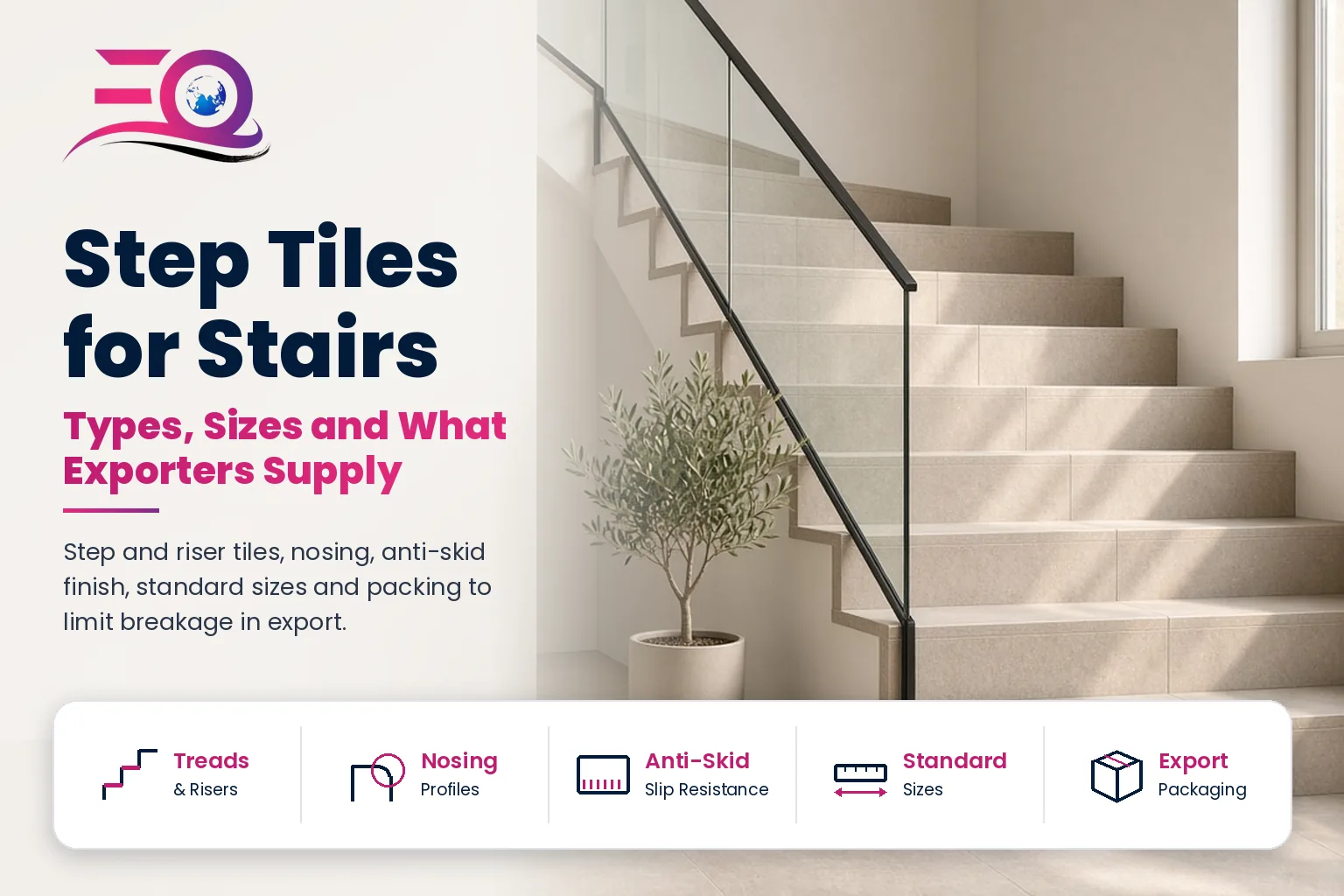
A staircase is the hardest-working piece of flooring in most buildings. Every step carries the full weight of whoever is climbing, the front edge takes the wear, and the one moment people stop watching their feet is the moment they're on the stairs. Tile that suits a hallway can be a poor choice here, and the mistakes show up fast: chipped edges, slippery treads, risers that don't match.
For importers and distributors, stair tiles are also a different kind of order from regular floor tiles. They are sold in sets and pieces rather than square metres, they are long and narrow, and they break more easily in transit.
This guide covers what the products are, how to specify them, and what to sort out with step tiles manufacturers before a container is loaded.
Understanding Stair Tread and Riser Sets
A finished stair uses two surfaces, and suppliers price and pack them separately.
The tread is the flat part people step on. The riser is the vertical face between one step and the next. Many buyers focus on treads and treat risers as an afterthought, then discover the matching riser has a different shade, a different thickness or isn't in the range at all.
Most step tile ranges are built as a family: a tread tile, a riser tile in the same design, and sometimes a landing tile to continue the pattern across the floor at the top or bottom. When you place an order, confirm that all three come from the same body and the same production run. If treads and risers are made separately, a visible tone change between the horizontal and vertical surfaces is a common complaint.
Stair Tile Nosing Types and Profiles
The nosing is the front edge of the tread, and it is where stair tiles get damaged, both in use and in transit. How it is formed is the biggest difference between one step tile and another.
There are broadly three approaches you'll see in supplier catalogues:
Cut and Shaped Edge Profiles
A standard tile has its front edge profiled or rounded. It's flexible and economical, but the edge is often the weakest point.
Moulded and Pressed Lip Profiles
The tile is produced with the nosing already formed, so the edge is part of the body. These typically cost more to make but give a cleaner, more consistent finish on site.
External Trim and Profile Options
Metal, PVC or stone-effect profiles are fitted over a plain tile edge. These are sourced separately and sit outside the tile supply itself.
None is universally better. A moulded lip suits projects that want a clean finished look with minimal site work; a cut edge suits cost-sensitive jobs where the fitter is experienced. What matters for you as a buyer is knowing which version your customers expect, because they will not be interchangeable once stock is on the shelf.
Anti-Skid Features and Slip Resistance
On stairs, slip resistance is concentrated where the foot lands and where it leaves: the front part of the tread. Many step tiles add grooves, ridges or a textured band near the nosing for exactly this reason, while the rest of the surface keeps a smoother look.
Two points are worth thinking through. First, a grooved edge helps grip but collects dirt, so it suits outdoor or high-traffic stairs more than polished indoor ones. Second, a finish that is fine dry may be very different when wet. If your customers are building external steps, entrances, or anywhere near water, our explanation of slip-resistant tiles for wet areas is worth reading, since the test methods and ratings discussed there apply directly to stair treads.
Contrast helps too. A tread edge that differs slightly in tone from the riser makes the step easier to read, which is useful for public buildings and for older users. It's a design choice, not a standard, but it's one dealers are often asked about.
Standard Stair Tile Sizes and Piece-Based Ordering
Step tiles are made in narrow, elongated formats because a tread is deeper than it is wide. Sizes vary between manufacturers, so check each supplier's current list instead of assuming a standard. Some typical patterns you'll come across:
- Treads are long rectangles, often built to span a standard stair width in one piece.
- Risers are shallower strips in the same length, matching the vertical height of a step.
- Landing or flooring tiles in the same design are usually offered in conventional square formats.
Because these are sold per step, quantity is best planned in pieces. Work out the number of steps your customers typically need, and make sure the ratio of treads to risers is right. A container with plenty of treads and too few risers is an awkward thing to explain.
When you compare quotes from step tiles manufacturers, a step tiles wholesaler or other step tiles B2B Exporters, ask each to price against the same piece counts so the figures are actually comparable.
Export Packaging and Breakage Prevention
Long, narrow tiles flex under their own length, and a formed nosing creates a thin, projecting edge. Together these make step tiles more fragile than standard floor tiles of the same body. Most breakage happens in handling and when loads shift, not because the tile was faulty.
Packing is therefore part of the product. Points worth confirming with the supplier:
- Edge and corner protection around the nosing, whether through inserts, protective board or wrap.
- How tiles sit in the carton. Long tiles are usually safer packed on the edge than flat, with no room to move.
- Palletising and strapping, so the load behaves as one unit during handling.
- A breakage allowance, agreed in writing, so there's a clear position if some pieces arrive damaged.
Our separate piece on how tiles are packed for export goes through cartons, pallets and container loading in more detail, and most of it applies to step tiles with extra attention on the edges.
Key Details to Include in Your B2B Inquiry
A good enquiry saves several rounds of back-and-forth. Include the number of steps or pieces you're aiming for, the tread and riser sizes you want, the surface finish and whether you need the nosing formed or plain. Mention the end use, such as indoor, outdoor or commercial, and say whether matching landing tiles are needed. Then ask the supplier how the pieces will be packed.
If you are still considering which supplier to choose for your requirements, you can look through the current options under step tiles of Eternal Overseas.
Talk to our export desk More guides
Frequently asked questions
What is the difference between a step tile and a riser tile?
A step tile, or tread, covers the horizontal surface you walk on, usually with a shaped or grooved front edge. A riser covers the vertical face between steps. Ranges often supply both in matching designs.
How should I plan quantities for stair tiles?
Plan in pieces rather than square metres: the number of steps, with matching treads and risers, plus any landing tiles. Check ratios carefully before confirming the order.
Do step tiles come with a built-in nosing?
Some do. The nosing may be moulded into the tile, cut into a standard tile, or added as a separate trim. Confirm which version a supplier is quoting, because they are not interchangeable.