
Buyer's Guide
One Piece Closet Manufacturers | Buying Guide for Importers
Compare one-piece and two-piece closets, P-trap and S-trap outlets, flush types, glaze quality and export packing before you place a container order.
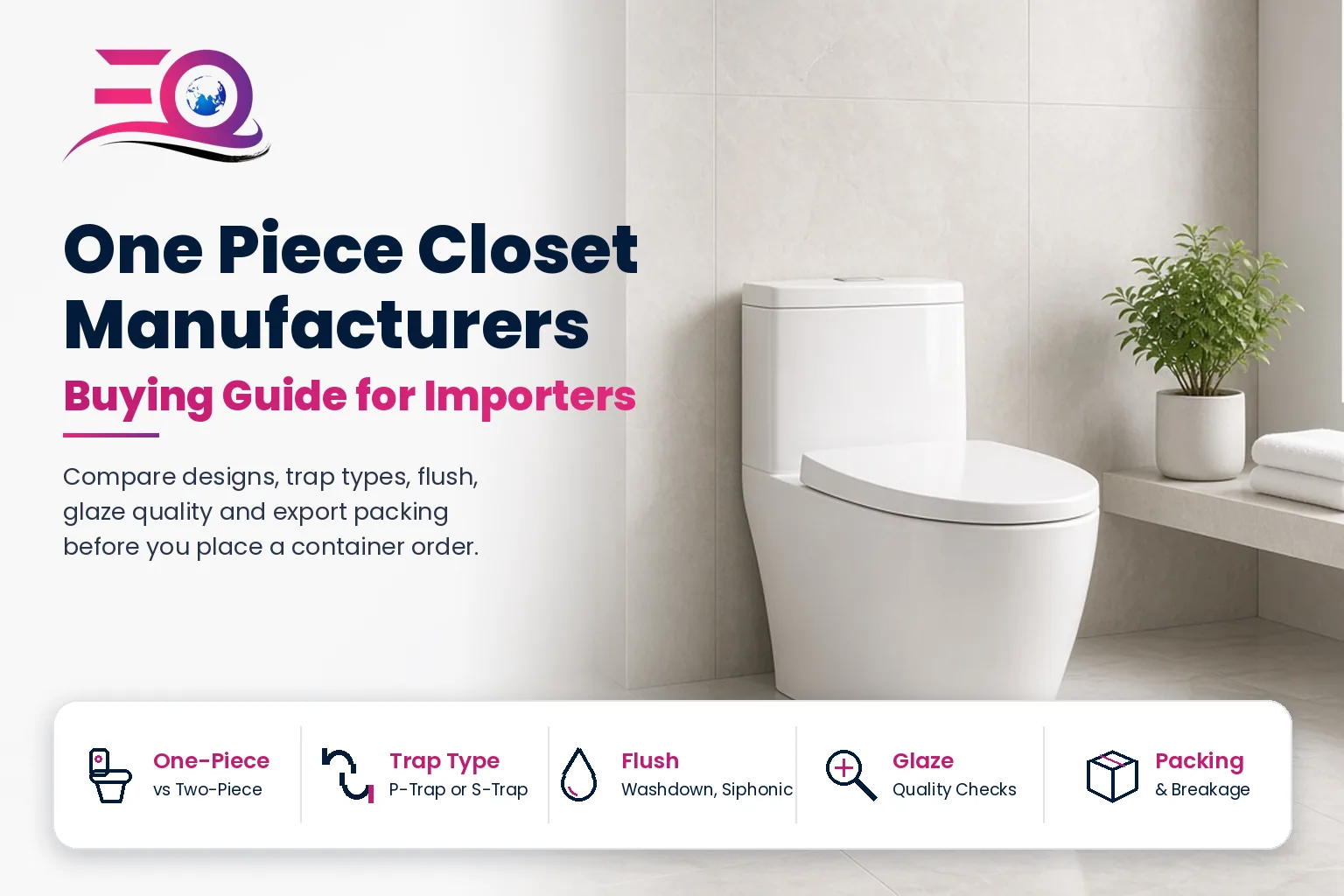
Choosing among one piece closet manufacturers looks simple on a price sheet, because the models resemble each other and the quotes sit close together. The differences show up later: an outlet that doesn't match your market's plumbing, a flush that needs a spare part nobody stocks, a glaze flaw you only see when the carton is opened at your warehouse. A closet is a bulky, fragile, low-margin product, so a bad container costs far more than a bad pallet of anything else in the bathroom range.
This guide goes through the decisions that matter most to an importer or distributor, in roughly the order they should be settled: design, trap type, flush, glaze, and finally how the goods travel.
One-Piece or Two-Piece: What Each Design Means for Your Stock
How the Two Designs Differ
In a one-piece closet the tank and bowl are cast as a single ceramic body. A two-piece closet has a separate cistern that sits on the bowl and is joined to it with a gasket and bolts.
| One-piece | Two-piece | |
|---|---|---|
| Construction | Tank and bowl form one unit | Tank and bowl made separately |
| Joints | Fewer, with no tank-to-bowl seal | A gasket and fixings to maintain |
| Handling | Bulkier and heavier per unit | Packed as separate pieces |
| If a part cracks | Often means replacing the whole unit | Tank or bowl can be replaced alone |
| Appearance | Continuous, closed profile | Visible step between tank and bowl |
Which Customers Buy Which
Contractors working to a budget often lean toward two-piece models, partly for that replaceability. One-piece models tend to appeal to buyers who want a cleaner look and an easier surface to wipe down. If you are building a first range, our one-piece closet listings are a useful reference for what a typical specification includes. Whichever way you go, a one-piece unit makes the quality of the casting and the packing matter more, since a single defect cannot be swapped out separately.
Trap Type: Settle the Outlet Before Anything Else
P-Trap and S-Trap in Plain Terms
The trap is the curved passage behind the bowl that keeps a water seal in place. A P-trap sends waste out horizontally, through the wall behind the closet. An S-trap sends it downward through the floor. Neither is better. The right one is whichever matches the drainage in the buildings your customers work on.
Rough-In Distance and Local Practice
Getting this wrong cannot be fixed on site without plumbing changes, so confirm it before anything else. Ask your own customers or local plumbers which outlet type dominates, and check the rough-in distance, meaning the measurement from the wall to the outlet centre. Ask the supplier for a dimensional drawing of each model instead of relying on the catalogue photograph. Where both trap types are used in your market, some importers hold both and let each model number carry its trap type clearly on the carton.
Flush Systems and Water Use
Washdown and Siphonic Bowls
A washdown bowl clears waste by the push of the flushing water alone. A siphonic bowl uses a siphon action to pull waste through the trap, which is typically quieter but more complex to cast. Both are common, and the choice affects how the bowl is made, so ask which one a model uses and whether the supplier can show how it performs.
Dual Flush and Cistern Fittings
Many markets set limits on water used per flush, so check the rules where you sell before choosing a flush volume. Dual-flush buttons are widely requested, but the mechanism inside the tank is a separate component from the ceramic. Ask who supplies the fittings, whether they are installed before shipping, and whether spare fill valves and flush units can be ordered later. A closet is hard to sell if the only repair part is unavailable.
Glaze Quality: What to Inspect
Defects Worth Rejecting
Glaze is the surface the end user sees and cleans every day, so inconsistencies matter more here than they would on a floor tile. Look for pinholes, blisters, uneven coverage, crawling (where the glaze pulls away and leaves bare patches) and visible colour differences between the bowl and the tank. Run a hand over the inside of the bowl and the trap opening, where glazing is hardest to do evenly. Hairline cracks are easier to spot with a torch held at an angle.
Test Reports and Samples
Ask the supplier for test reports against the standard your market recognises, and check that each report names the model you are buying. Then order a sample unit. Flush it, fill the tank and leave it for a day to check for seepage, and compare the seat fit and the colour match. Keep the sample as your reference once production begins.
Packing, Breakage and Container Loading
How the Pieces Should Be Packed
Each closet should be in its own carton with enough protection to keep ceramic from touching ceramic: corner protectors, a fitted insert or cushioning, and a bottom that can bear weight. The tank lid and the other small pieces need separate protection, as these are among the most commonly broken parts. Ask to see a photograph of a packed carton before shipment.
Loading and Breakage Terms
How many closets fit in a container depends on the model and the carton size, so ask for the figure per container for each model and have your forwarder confirm it. Stacking height and bracing affect breakage, so ask how the load will be secured. Agree in writing how damaged units are handled and what percentage, if any, is allowed for breakage, before the order is confirmed and not after the cartons arrive.
Comparing One Piece Closet Supply Channels
Who Does What
A direct factory gives you control of specifications and production batches. A one piece closet wholesaler may combine models from several plants, which can help when you want a mixed order. Many one piece closet B2B exporters offer a mix of both roles along with documentation and loading. Judge each by how clearly they describe where the goods are made and who is responsible if units arrive damaged.
Seats and Other Accessories
Some buyers search for one piece toilet seat manufacturers when what they need is a complete closet with the seat included. The seat is a separate component, commonly made from plastic and sometimes fitted with soft-close hinges, and it may or may not be part of the quoted price.
Confirm whether the seat is supplied with the closet, what it is made of, and whether the hinge fittings match the bowl's mounting holes.
If you’re looking for a high-quality sanitaryware products range, partner with Eternal Overseas, a trusted exporter. Tell us the models you are considering, the trap type, flush preference, whether you need the seat supplied, and the quantity you have in mind. Our team can respond with specifications, sample options and packing details. Contact Eternal Overseas to begin.
Talk to our export desk More guides
Frequently asked questions
Should I Order P-Trap or S-Trap Models?
It depends on the drainage in your market. A P-trap outlet goes through the wall, and an S-trap goes through the floor. Check with local plumbers and get a dimensional drawing for each model.
What Is the Difference Between a One-Piece and a Two-Piece Closet?
A one-piece closet has the tank and bowl cast as a single unit. A two-piece closet has them made separately and joined with a gasket and bolts, so each can be replaced on its own.
How Do I Reduce Breakage in a Closet Shipment?
Ask for individual cartons with proper cushioning, protected tank lids, secure palletising and bracing in the container, and agree to a written breakage policy before you order.